
Recent discoveries, across a wide range of eukaryotes, have identified ‘specialised ribosomes’ – compositionally distinct ribosomes that actively regulate mRNA translation. This is achieved by specific ribosomes preferentially translating either a) specific mRNAs or b) specific open reading frames (ORFs). Both mechanisms result in the synthesis of distinct proteomes by different ribosome populations.
What is missing?
The link between ribosome compositional changes, the structural effect of these changes and their downstream impact on translation remains elusive. Additionally, although numerous examples of specialised ribosomes have been discovered in a range of organisms from yeast to humans, common mechanistic features of how specialisation occurs are yet to be identified.
Vision
We propose a novel, systematic approach that integrates comparative genomics, molecular genetics, structural biology and emerging technologies with experimentally tractable model systems: animals, plants and yeast, covering 1 billion years of eukaryotic history.
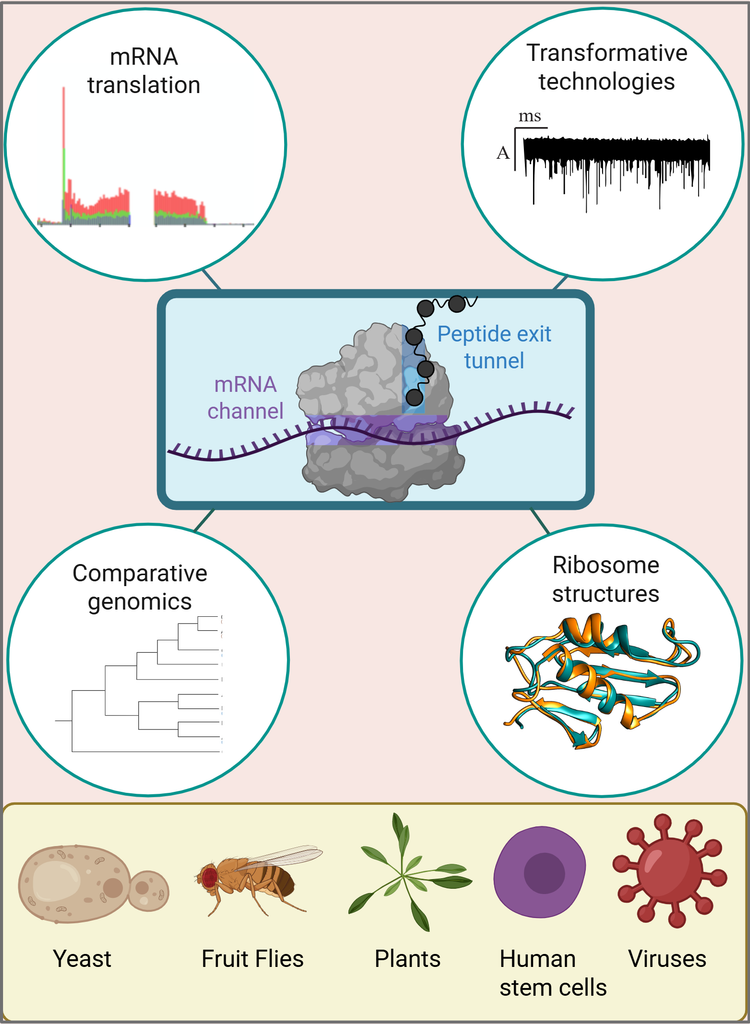
The consequences of changes in ribosome composition on structure, mRNA selection and protein translation will be experimentally dissected in these diverse species, enabling us to determine both:
a) detailed molecular mechanisms
b) common features of specialisation across models.
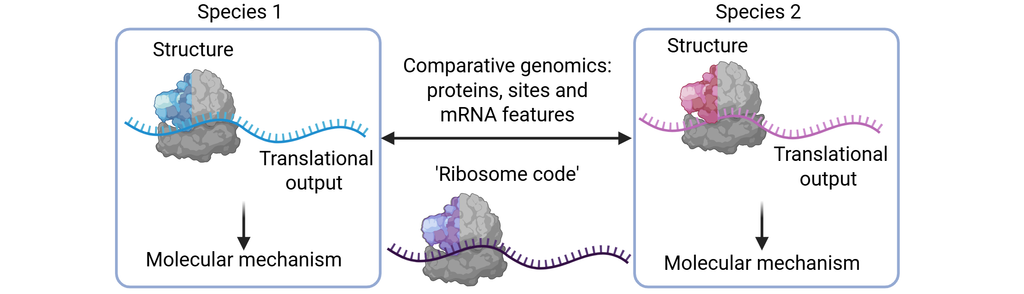
Critically, using comparative genomic approaches, we will identify common features across all eukaryotes and predict uncharacterised sites of ribosome specialisation. The hypotheses we will develop will then be tested in our model systems (Fig. 1). Our broad evolutionary perspective will allow us to focus on conserved, functionally important regions of the ribosome.
RiboCode will:
- Provide an unprecedented understanding of how specialised ribosomes regulate translation at the molecular level through changes in their composition.
- Reveal the critical sites of ribosome specialisation across eukaryotes.
- Generate a ‘ribosome code’ to explain the observed common mechanistic features of how specialised ribosomes regulate translation across eukaryotes.
- Employ the ‘ribosome code’ to predict additional routes of specialisation to provide the potential for future engineering of gene expression.
- Develop new biophysical techniques to probe the ‘ribosome code’.